Magnesium Hydroxide & Aluminum Hydroxide: Which One Is Better for Flame Retardant?
Introduction
Nowadays,if you are considering the selection of flame retardant fillers for halogen-free systems, the materials that you will probably come across most often are Magnesium Hydroxide and Aluminum Hydroxide.
Both are eco-friendly and non-halogenated flame retardants that find a wide application in cable compounds, EVA, rubber, and engineering plastics. However, their performances vary greatly depending on the processing temperature, the amount of the filler, and the end-use application.
This article will provide you with a detailed comparison between Magnesium Hydroxide and Aluminum Hydroxide at the technical level so that you can better understand and select the appropriate product.
1. Flame Retardant Mechanism (Why they work)
Magnesium Hydroxide and Aluminum Hydroxide work on similar principles:
They absorb heat by undergoing an endothermic decomposition.
The water vapor they release dilutes the combustible gases.
At the same time, they form a protective layer of metal oxide that acts as a barrier.
The key difference is that:
Aluminum Hydroxide decomposes at a temperature of approximately 180–200°C
Whereas
Magnesium Hydroxide decomposes at a temperature of approximately 330°C
The above difference essentially defines the range of each one can be used.
2. Processing Temperature (The deciding factor)
| Feature | Magnesium Hydroxide | Aluminum Hydroxide |
| Decomposition Temp | 330°C | 200°C |
| Processing Temp | High | Low |
| Typical Use | Engineering plastics | EVA, PE |
Explanation:
Since Aluminum Hydroxide is a material of a particular nature, it is not feasible for
high-temperature processing
Magnesium Hydroxide is appropriate for:
XLPE cable
Engineering plastics
High-temperature polymers
In fact, if you are processing temperatures beyond 220°C, then you can only use Magnesium Hydroxide.
3. Flame Retardancy Performance
| Feature | Magnesium Hydroxide | Aluminum Hydroxide |
| Typical Loading | 50–65% | 60–70% |
| LOI Capability | Greater | Average |
| Smoke Generation | Lower | Fair |
Understanding is that:
Magnesium Hydroxide is normally the one which needs the least loading even when equal or superior levels of flame retardancy are attained.
Lower loading means also better mechanical properties.
4. Effect of Mechanical Properties
High filler content impairs:
Strength of material
Ability to be bent
Aluminum Hydroxide leads to higher filler content and consequently more brittle materials.
Magnesium Hydroxide results in lower filler content and improved flexibility.
When it comes to cables, this difference is quite game-changing.
5. Cost vs Performance
| Factor | Magnesium Hydroxide | Aluminum Hydroxide |
| Raw Material Cost | Higher | Lower |
| Efficiency | Higher | Lower |
| Total Formulation Cost | Comparable | Comparable |
Reality:
Despite the fact that Magnesium Hydroxide costs quite a bit more per ton:
There is a strong chance that you will use less of it
So when it comes to real formulations, the cost differences are not as big as one can think.
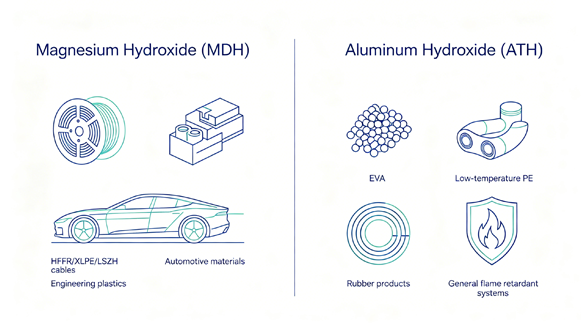
6. Typical Applications
HFFR cable compounds
XLPE / LSZH cable
Engineering plastics
Automotive materials
EVA
Low-temperature PE
Rubber products
General-purpose flame retardant systems
7. When to Choose Magnesium Hydroxide vs Aluminum Hydroxide
Choose Magnesium Hydroxide if:
Processing temperature > 220°C
You want the mechanical properties to be better
You want higher level of flame retardancy
The material you are working with is cable or engineering plastics
Choose Aluminum Hydroxide if:
You need low-cost system
Processing temperature < 200°C
You are using EVA or standard PE
8. Practical Recommendation (From Real Applications)
Today many HFFR cable formulas incorporate:
Magnesium Hydroxide rather than Aluminum Hydroxide because:
Better thermal stability
Lower smoke emission
Improved mechanical performance
Many high-end cable manufacturers now use:
Surface-treated Magnesium Hydroxide with optimized particle size
to improve dispersion and overall performance.
9. FAQ
Is magnesium hydroxide better than aluminum hydroxide?
It depends on the application. MDH is better for high-temperature processing and high-performance flame retardancy, while ATH is more cost-effective for low-temperature systems.
Why does MDH perform better in cables?
Because cable materials often require higher processing temperatures, where ATH would decompose too early.
In many high-end applications, yes. However, ATH is still widely used in cost-sensitive and low-temperature systems.
What is the main limitation of MDH?
Higher cost and sometimes more difficult dispersion without surface treatment.
10. Conclusion
Both Magnesium Hydroxide and Aluminum Hydroxide are essential flame retardant fillers.
However, the choice depends on:
Processing temperature
Mechanical requirements
Cost-performance balance
In high-performance and high-temperature applications,
magnesium hydroxide is generally the better choice.