Buying Inorganic Fillers? Here’s Why Whiteness Index Is Your #1 Metric
What is Whiteness?
Simply put, whiteness is a numerical indicator of how close the surface color of an object is to pure white. It represents an object's ability to reflect visible light (especially in the blue light band, approximately 457nm).
Principle: The color of an object we see depends on its reflection and absorption of different wavelengths of light. An ideal "pure white" object would reflect all wavelengths of visible light equally and with high intensity. In reality, the reflection of most materials is not perfectly uniform. Whiteness is a numerical value calculated by comprehensively measuring its reflective properties to determine how close it is to "ideal white."

Measurement: Measurement is performed using a whiteness meter or colorimeter. The instrument emits a standard light source, measures the reflectance of the sample at a specific wavelength (especially the dominant wavelength of 457nm) (blue light reflectance R457 is a key parameter), and combines this with other chromaticity coordinates to calculate the final whiteness value using mathematical formulas (such as the CIE whiteness formula, Ganz whiteness formula, Hunter whiteness formula, etc.).
Numerical Range: Typically, whiteness values range from 0 to 100 (some formulas may exceed 100). 100 represents an ideal total internal reflection diffuser (theoretically the whitest), while lower values indicate a deviation from white (potentially appearing yellowish, grayish, or blackish).
What does whiteness represent in inorganic powder materials?
For inorganic powder materials (such as magnesium hydroxide, talc, calcium carbonate, barium sulfate, kaolin, titanium dioxide, etc.), whiteness is not merely a color indicator; it is a crucial comprehensive quality indicator that directly impacts product value and application. It primarily represents the following:
1. A direct reflection of purity and impurity content.
This is the core industrial significance of whiteness. The whiteness of inorganic powders is highly correlated with their chemical purity and the type/content of impurities.
Common impurities that reduce whiteness:
Organic matter: Such as humic acid and asphalt associated with minerals, which can cause materials to appear grayish or blackish.
Coloring metal ions: such as iron (Fe³⁺/Fe²⁺), manganese (Mn), titanium (Ti), chromium (Cr), copper (Cu), etc. Even trace amounts (tens of ppm) of iron oxide can cause noticeable yellow or red hues.
Black spot impurities: Dark mineral particles that are not completely separated in the mineral (such as mica, tourmaline, etc.).
Conclusion: Higher whiteness generally indicates better processing and purification techniques, lower impurity content, and higher product purity.
2. Indicator of Processing Technology Level Whiteness is a "litmus test" for measuring the level of process control throughout the entire process, from mining and beneficiation to crushing, calcination, and surface treatment.
Calcination: For materials such as kaolin and alumina, calcination can remove organic matter and structural water, significantly improving whiteness (e.g., calcined kaolin).
Bleaching and Impurity Removal: Processes such as magnetic separation (to remove iron-containing minerals), flotation, and chemical bleaching (e.g., reducing Fe³⁺ with sodium dithionite) aim to remove coloring impurities, with the core indicator being improved whiteness.
Pulverization and Classification: Fine pulverization and strict classification can remove some impurities, resulting in purer, whiter powders.
3. Key Factors Determining Product Application Performance and Value: Whiteness directly affects the quality and appearance of downstream products.
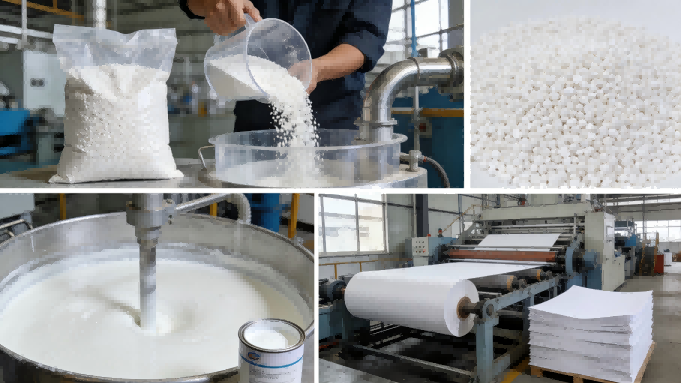
Filling Materials: In plastics, rubber, coatings, and papermaking, high-whiteness inorganic powders do not "contaminate" the color of the filled products, giving them a brighter and purer base color. Examples: High-end plastic masterbatches, coatings and paints, papermaking.
Functional Materials:Titanium dioxide (titanium white powder), food, pharmaceutical, and cosmetic grade powders.
Summary
In the inorganic powder materials industry, whiteness is a comprehensive core quality parameter that closely links "appearance color," "internal purity," "process level," and "application performance."
For manufacturers, whiteness is a benchmark for technical level and product grade.
For buyers and users, whiteness is the first and most intuitive threshold for selecting qualified suppliers and ensuring the quality of the final product.
Therefore, whiteness is a key technical indicator that must be labeled in the technical standards, procurement contracts, and research reports of relevant products.