Powder clumping and unstable processing? It might be due to "moisture"—a comprehensive analysis of its influencing mechanisms.
I. What is Moisture?
In industrial production and materials science, moisture generally refers to the total amount of water contained in a substance. However, based on the form and state of water's existence, it can be subdivided into several levels:
1.Surface Adsorbed Water (Free Water):
Definition: Water physically adsorbed on the surface and in the pores of a material. Moisture usually originates from environmental humidity.
Characteristics: The weakest binding force, and the easiest to remove by room temperature drying (e.g., oven drying).
Example: Water adhering to the surface of powder particles after being placed in humid air.
2.Internal Bound Water:
Water of Crystallization: Exists in the crystal lattice of minerals as water molecules within the crystal structure (e.g., gypsum CaSO₄·2H₂O, copper sulfate pentahydrate CuSO₄·5H₂O). It has a stronger binding force and requires higher temperatures (e.g., several hundred degrees Celsius) to remove; removal destroys the crystal structure.
Structural water/hydroxyl water: Exists in the form of hydroxyl groups (-OH) in the mineral lattice (e.g., Al₂Si₂O₅(OH)₄ in kaolinite, Al(OH)₃ in aluminum hydroxide). The binding force is very strong, requiring very high temperatures (typically > 500°C) to remove it as water molecules, leading to a fundamental change in the material structure.
3.Chemically bound water:
Water participates in chemical reactions, becoming part of new compounds. This concept sometimes overlaps with water of crystallization, but emphasizes its irreversible chemical change.
In the daily production, trade, and application of inorganic powder materials, the term "moisture" usually refers by default to the most easily changed "surface-adsorbed water (free water)."
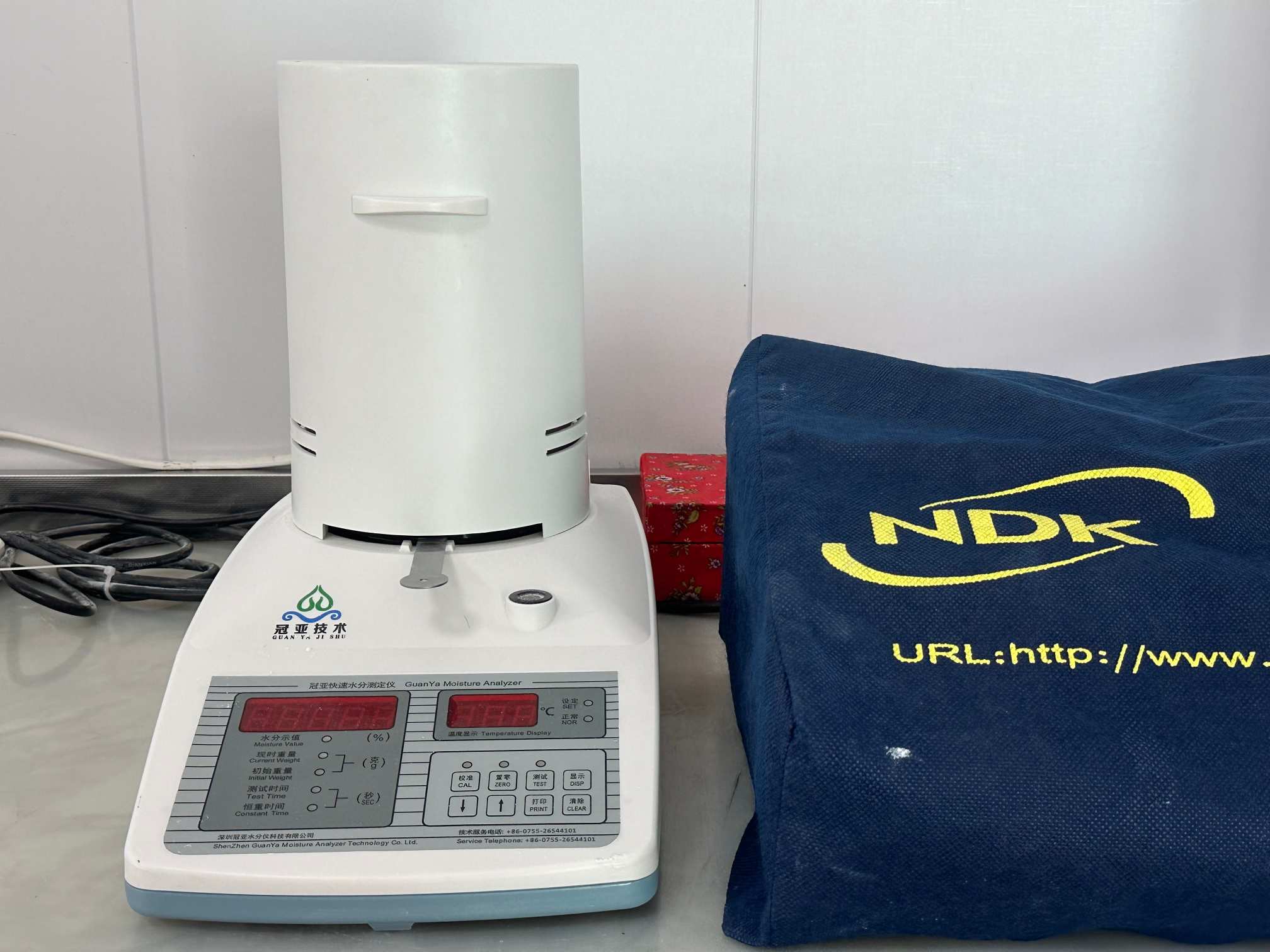
II. What does moisture represent in inorganic powder materials?
For inorganic powder materials, moisture is far more than a simple "content" indicator; it is a key quality, process, and economic parameter with multifaceted effects:
1.Impact on material properties:
Flowability: Moisture is one of the most significant factors affecting the flowability of powders. Small amounts of moisture can form "liquid bridges" between particles, generating capillary forces that cause powder agglomeration and a sharp decline in flowability (as seen in the hygroscopic effects of sugar and flour). This is disastrous for conveying, packaging, and automated metering.
Bulk Density and Filling Properties: Moisture affects interparticle friction and agglomeration, thus altering both bulk density and tapped density.
Electrical Properties: For powders used as electrical insulation materials (such as ceramics and mica), moisture significantly reduces their volume resistivity.
Optical Properties: For pigments (such as titanium dioxide) and fillers, moisture affects their whiteness, hiding power, and dispersibility.
Chemical Reactivity: Moisture can sometimes trigger or promote undesirable chemical reactions, such as the oxidation of certain metal powders and the prehydration of cement.