The "Secret" of Paint Formulators: How Do Small Stones Support the Vast World of Paint?
In the paint industry, there's a saying: "A large bucket of paint, half a bucket of minerals!" While it may sound exaggerated, it reveals the core role of non-metallic minerals in paints.
Step into a paint production workshop, and you'll find that the key factors determining paint performance are often hidden in unassuming white powder. They are the "skeleton" and "muscle" of the paint—providing support for the film-forming substance, giving the coating its function, and allowing expensive resins to "spend less and do better."
I. Why Can't Paints Do Without Non-metallic Minerals?
The basic paint formulation consists of four main components: film-forming substance (resin), solvent, pigment, and filler. Among these, non-metallic minerals primarily play the role of functional fillers.
Their value is reflected in two dimensions:
1. Economic Dimension: Cost Reduction and Efficiency Improvement
Titanium dioxide costs tens of thousands of yuan per ton, while calcium carbonate only costs a thousand yuan. The rational use of mineral fillers can significantly reduce formulation costs while ensuring performance.
2. Functional Dimension: Performance Enhancers
Different mineral crystal structures endow coatings with different "superpowers"—corrosion shielding, increased hardness, rheology control, gloss adjustment… These functions are often beyond the capabilities of resins alone.
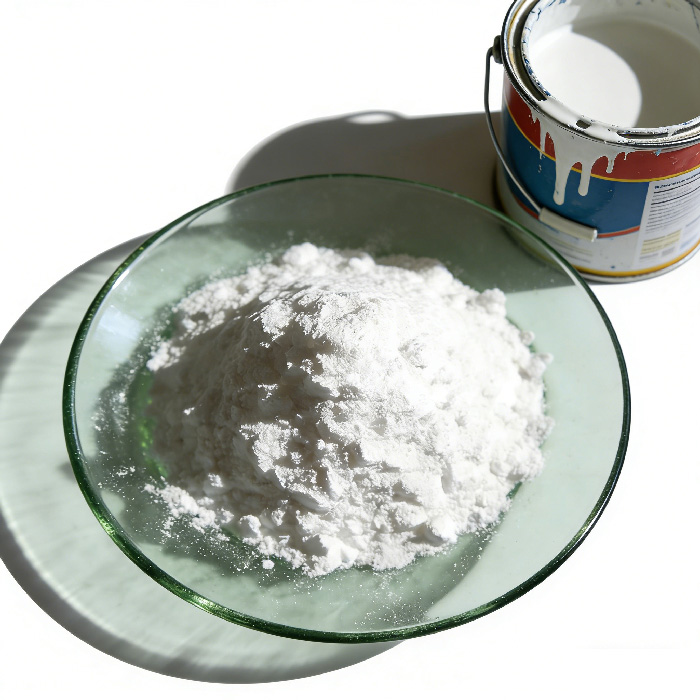
II. Analysis of the Application of Non-metallic Minerals in Coatings
1. Calcium Carbonate (CaCO₃)—The "First Filler" in Coatings
Identity Profile: Main component is calcium carbonate, divided into heavy calcium carbonate (ground ore) and light calcium carbonate (chemical precipitation). It has high whiteness and stable chemical properties, making it the most widely used filler in the coatings industry.
Role in Coatings:
Volume Increase and Cost Reduction: Fills volume, replaces part of the resin, and is the main filler in primers and low-to-mid-range latex paints, with an addition amount of 20%-40%.
Application Friendly: Improves the build-up and sandability of coatings, preventing film sagging.
Optical Adjustment: Light calcium carbonate has high oil absorption and can be used for matting; ultrafine heavy calcium carbonate provides a certain degree of hiding power.
Application Scenarios: Interior wall latex paint, primer, putty
2. Kaolin (Al₂O₃·2SiO₂·2H₂O) – The “Shielding Guardian” of Coatings
Identity Profile: Hydrated aluminum silicate, plate-like crystal structure, divided into washed clay and calcined clay. Calcination results in higher whiteness and increased porosity.
Functions in Coatings:
Shielding Enhancement: The layered, sheet-like structure in the coating film extends the penetration path of moisture and corrosive media.
Suspension and Anti-settling: Improves the storage stability of coatings and prevents pigment sedimentation and clumping.
Dry Hiding Power: The microporous structure of calcined kaolin creates an "air-mineral" interface, effectively scattering light and partially replacing titanium dioxide.
Application Scenarios: Architectural latex paints, primers, industrial paints
3. Talc (3MgO·4SiO₂·H₂O) – The "Flexible Role" for Weather Resistance and Corrosion Protection
Identity: Hydrated magnesium silicate, sheet-like or fibrous structure, soft texture, and smooth feel.
Its role in coatings:
Corrosion barrier: The parallel arrangement of its sheet-like structure effectively blocks water and oxygen penetration, significantly improving the coating's corrosion resistance.
Improved feel: Gives the paint film a unique smooth touch, improving sandability.
Weather resistance and crack resistance: Reduces internal stress in the coating film caused by temperature changes, lowering the risk of cracking.
Applications: Anti-corrosion primers, automotive putty, exterior wall coatings
4. Bentonite—A "Stabilizer" for Coating Storage
Identity Profile: A layered clay mineral primarily composed of montmorillonite, possessing excellent water absorption, ion exchange, and thixotropic properties.
Functions in Coatings:
Thixotropic Thickening: Forms a gel network in water-based or solvent-based systems, preventing pigment sedimentation and sagging.
Application-Friendly: Gives coatings the characteristic of being "thick when still, thin when stirred," facilitating spraying and brushing.
System Compatibility: Sodium-based bentonite is used in water-based coatings, while organically modified bentonite is required for solvent-based coatings.
Application Scenarios: Water-based paints, solvent-based paints, inks
III. Conclusion: Small Minerals, Great Wisdom
For coating formulators, understanding the crystal structure, surface properties, and mechanisms of action of these minerals is like a chef mastering the characteristics of each seasoning. Only in this way can the optimal balance between performance and cost be found, resulting in coating products that are both economical and excellent.